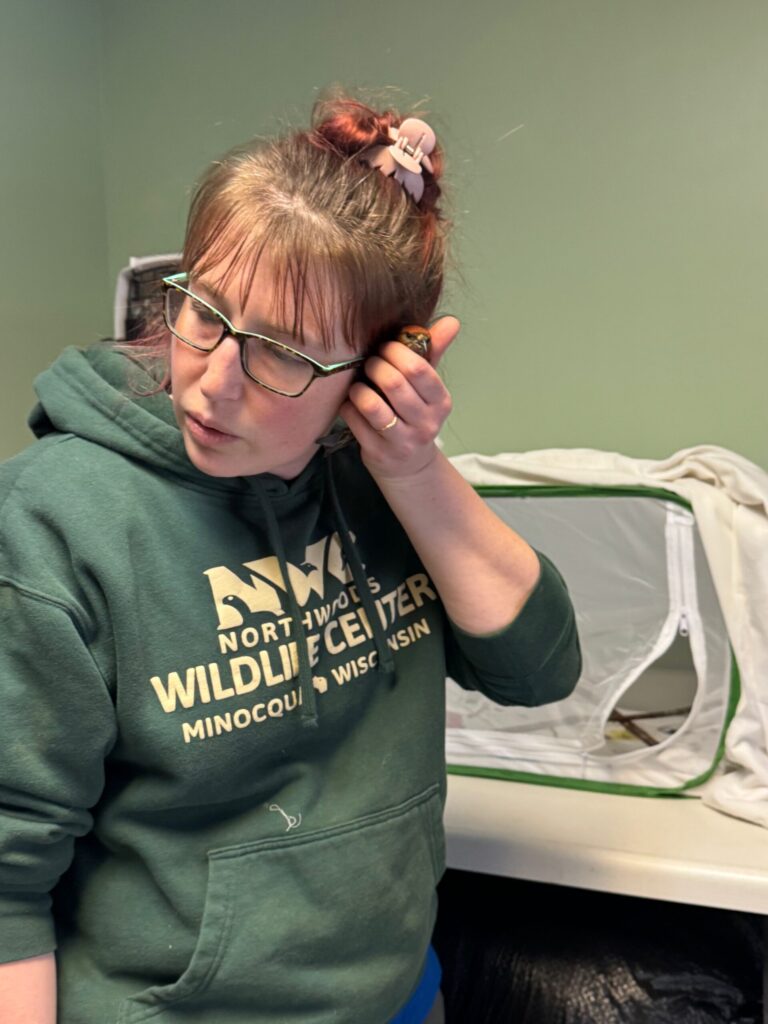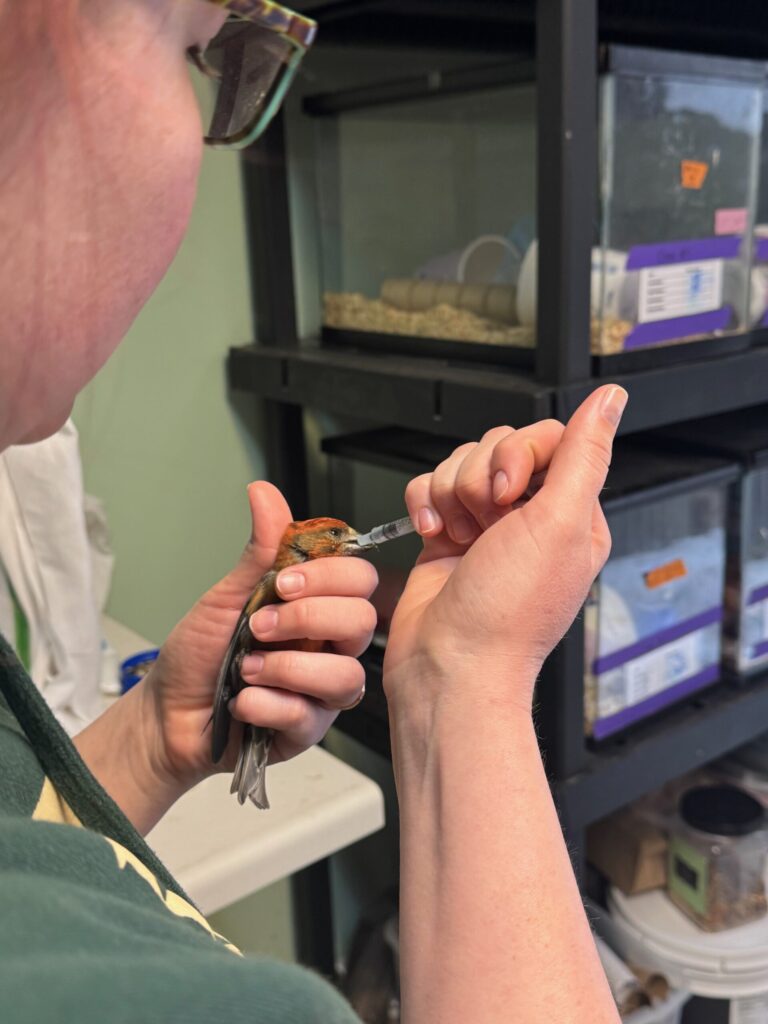
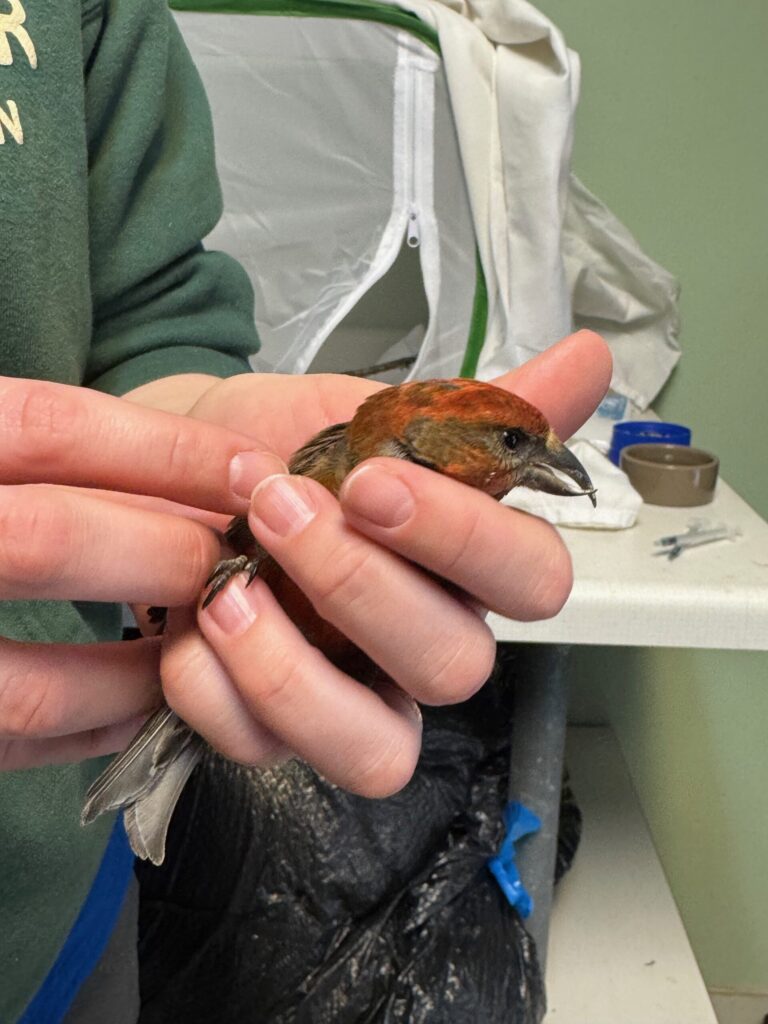
On Monday, a caring citizen brought us a red crossbill that had been hit by a car and was floundering on the side of the road.
Red crossbills are really cool birds. They are considered uncommon in northern Wisconsin, and are rarely patients here at the Center. Typically found in the boreal zone, (a northern ecosystem that stretches across Canada, Alaska, and Eurasia with cold weather and a continuous belt of coniferous forest), they can migrate in large flocks to northern Wisconsin in the winter. We owe the pleasure of seeing them here in the northwoods to our spruce, pine, and hemlock trees. Red crossbills are here for the seeds found in the cones of these conifers, a food source they access using their incredibly unique bills.
In fact, it was the criss-cross shape of the red crossbill’s bill that was a large part of the concern of the citizen who brought the bird to the Center on Monday. As Bend Heinrich writes in his book Winter World, “Crossbills’ bills look misshapen, as from some developmental defect. Their long and slender (for a finch) two-centimeter-long upper bill crosses over a one-half centimeter shorter lower bill. By inserting their partially open bill under a [spruce or pine] cone bract and then closing the bill, the bill-tips separate by about 3 millimeters, applying strong leverage laterally so that the bract is pried away from the cone. The seeds under it can be reached with the tongue.”
The criss-cross of our crossbill’s bill was exactly the way a crossbill’s bill was supposed to be, but sadly, the other injuries it sustained from the impact with the car (head trauma, and our rehabbers also identified respiratory issues) were substantial. For two days our rehabbers cared for and monitored the red crossbill. Although we remained hopeful that recovery and release might be possible, and the red crossbill was calm and even attempted to eat, yesterday, it died naturally.
Although they are mostly here for conifer cones, red crossbills are known to congregate by roadsides to peck at salt and grit, and most likely, that is what this one was doing when it was hit by a car.
Whenever wildlife doesn’t make it, we think about lessons learned. Even though winter isn’t necessarily the primary season during which motorists might accidentally hit a songbird, the red crossbill brought into the center confirmed that we’ve got crossbills visiting, they might be congregating on our roadsides, and keeping an extra eye out certainly won’t hurt.