
For many of us, the call of a loon at dusk or the sight of a bald eagle cruising the shoreline is part of what makes life on a Northwoods lake so special. But there is a hidden threat in our waters and on our landscapes that is taking a serious toll on these iconic birds: lead from fishing tackle and hunting ammunition. Lead is a powerful neurotoxin. There is no known safe level of exposure for people or wildlife. Even a single small lead sinker, jig, or bullet fragment can be enough to kill a loon or an eagle.
How Lead Tackle Kills Loons
Loons pick up small pebbles from lake bottoms to help grind their food. Unfortunately, lost or discarded lead sinkers and jigs are very similar in size and shape to the grit they naturally ingest. Once swallowed, the lead is quickly ground down in the loon’s gizzard and absorbed into the bloodstream.
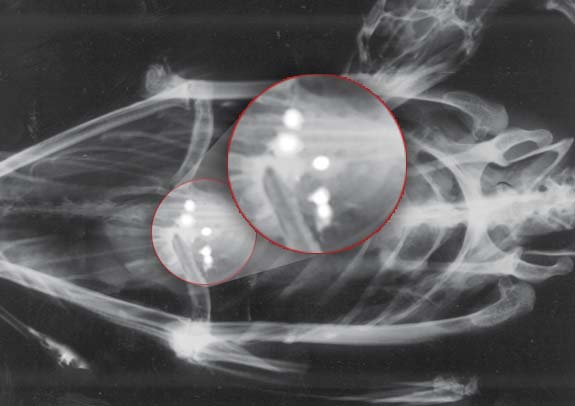
Multiple studies have shown just how deadly this is:
Research in New England found that nearly half of adult loons found sick or dead during the breeding season died from lead poisoning due to ingested lead fishing weights.
A Wisconsin review of loon deaths found that about 30% of loons submitted for necropsy died of lead poisoning; in every confirmed case, remnants of lead tackle were found in the bird’s digestive tract.
In New Hampshire, a 24-year study concluded that ingested lead fishing tackle was the leading known cause of death for adult loons and that lead tackle had reduced the state’s loon population growth and overall numbers by more than 40% during the study period.
These are preventable deaths, stemming from a material we now know how to replace with non-toxic alternatives.
Eagles and Lead from Hunting Ammunition
Bald eagles and other raptors are exposed to lead in a different way. When deer or other game are shot with traditional lead ammunition, the bullet often fragments into dozens or even hundreds of tiny pieces along the wound channel. Those fragments remain in the carcass or gut pile left in the field, where scavengers like eagles feed.
The U.S. Geological Survey recently reported that almost half of the bald and golden eagles sampled nationwide showed evidence of repeated lead exposure. Lead poisoning typically occurred when eagles ate bullet fragments lodged in carcasses or gut piles from hunter-shot animals.
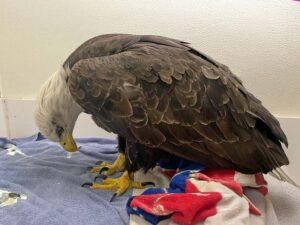
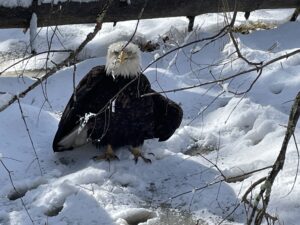
Wildlife health specialists note that even low-level, “sublethal” exposure affects the nervous system and digestive tract, causing weakness, disorientation, and impaired coordination. For birds that must fly, hunt, and maneuver with precision, these subtle effects can be the difference between life and death.
Subtle Poisoning, Real-World Consequences
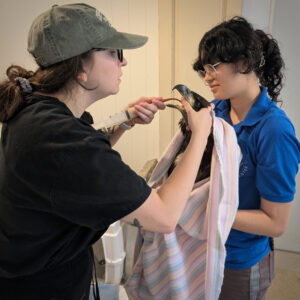
At the Northwoods Wildlife Center, we suspect that most of the loons and eagles admitted to our clinic have at least some level of lead exposure. Every bird we test shows some degree of lead poisoning.
Even when the exposure is not immediately fatal, the neurological and physiological effects are serious. Lead slows reaction times, interferes with balance and coordination, and suppresses the immune system. Birds become weaker flyers, slower to take off from the water or roadside, and less able to avoid predators, boats, or cars. They are more likely to be hit by vehicles or injured by other hazards, and they are at higher risk for parasites and infectious disease.
In short, lead makes everything harder for these birds—surviving winter, raising chicks, migrating, and simply staying out of harm’s way.
The Northwoods Wildlife Center’s “Lead Out” Program
Recognizing the scope of the problem, the Northwoods Wildlife Center has launched a Lead Out program to reduce lead in our local environment and educate the public about its dangers to wildlife.
Through this effort, we are:
- Collecting old and unwanted lead fishing tackle and, where possible, helping anglers switch to non-toxic alternatives.
- Sharing information with anglers, hunters, and lake residents about how and why lead harms loons, eagles, and other wildlife.
- Encouraging the use of non-lead ammunition for hunting and non-lead tackle for fishing, both of which perform well and are increasingly easy to find.
Our goal is simple: less lead in the environment, less loons and eagles suffering from preventable poisoning.
To safely dispose of your lead, you can drop it off at:
Northwoods Wildlife Center
8683 S. Blumenstein Rd.
Minocqua, WI 54548