
A Northwoods Wildlife Center guide to identifying, understanding, and living alongside Wisconsin’s squirrels and chipmunks.
Meet Wisconsin’s common squirrels and chipmunks
You’ve probably seen them darting across your lawn, disappearing beneath a woodpile, or scurrying up a tree. Chipmunks, ground squirrels, and tree squirrels are familiar neighbors throughout Wisconsin. But how can you tell them apart?
Although they share many characteristics, these small mammals have different appearances, behaviors, habitats, and strategies for surviving Wisconsin’s changing seasons.
And here’s something that might surprise you: chipmunks are squirrels! All three belong to the squirrel family, but not all squirrels live in trees.
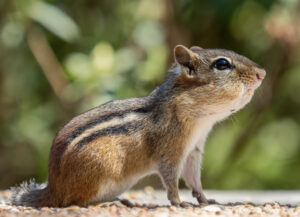
Eastern chipmunk
Tamias striatus
Recognizable by its dark and light stripes running along its back and face. Chipmunks spend much of their time on the ground, gathering seeds, nuts, and other foods in expandable cheek pouches. They retreat into underground burrows for shelter and winter dormancy.
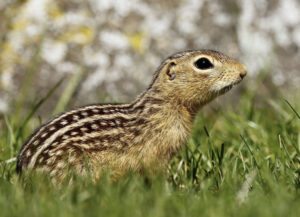
Thirteen-lined ground squirrel
Ictidomys tridecemlineatus
Often mistaken for a chipmunk, this slender ground squirrel has alternating light and dark stripes, with rows of pale spots along its back. It favors open grassy areas and spends much of the winter in deep hibernation.
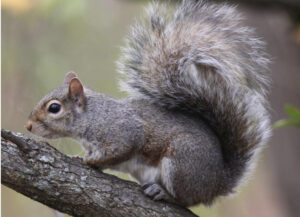
Eastern gray squirrel
Sciurus carolinensis
One of Wisconsin’s most recognizable tree squirrels. Gray squirrels have bushy tails, are excellent climbers, and remain active during winter. Some individuals are black because of a natural variation in pigmentation.
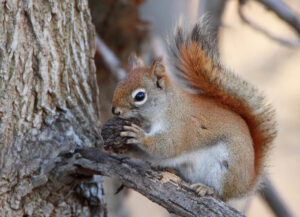
American red squirrel
Tamiasciurus hudsonicus
Smaller than the gray squirrel and especially common in northern forests. Red squirrels are energetic, vocal, and fiercely protective of their food caches, particularly stores of conifer cones.
Fox squirrel
Sciurus niger
Wisconsin’s largest native tree squirrel, typically featuring a rusty-orange underside and a substantial bushy tail. Fox squirrels are more associated with open woodlands, farms, and urban landscapes.


How do squirrels and chipmunks survive winter?
Winter is one of the most fascinating differences among these animals.
Chipmunks spend much of the winter underground in a state of dormancy. Their body temperature and metabolism decrease, but they periodically wake to eat food stored in their burrows.
Thirteen-lined ground squirrels are true hibernators. Their body temperature and heart rate drop dramatically, allowing them to survive months underground on stored body fat.
Tree squirrels remain active year-round. They rely on cached nuts and seeds, insulated nests, and shelter during particularly harsh weather.
Living with chipmunks and squirrels
Squirrels and chipmunks play important roles in healthy ecosystems. They disperse seeds, serve as prey for hawks, owls, foxes, and other predators, and contribute to the complex food web of our forests and fields.
However, sharing a backyard with wildlife sometimes creates challenges.
How to discourage unwanted digging
Chipmunks and ground squirrels may dig around gardens, landscaping, retaining walls, and other structures.
The best approach is prevention rather than removal.
- Protect vulnerable bulbs and garden beds with securely installed hardware cloth.
- Remove spilled birdseed and avoid leaving pet food outdoors.
- Seal gaps around buildings with appropriate chew-resistant materials, after confirming no animals are inside.
- Avoid placing attractive food sources near foundations or other sensitive areas.
- Never seal an occupied burrow or entrance without first determining whether animals or dependent young are inside.
For persistent damage, seek advice from a qualified wildlife professional about humane, lawful exclusion methods.
Should you feed chipmunks and squirrels?
Watching squirrels and chipmunks can be entertaining, but deliberately feeding them is generally discouraged.
Feeding can encourage animals to congregate, lose their natural caution around people, or repeatedly visit areas where they may encounter pets, vehicles, and other hazards.
Instead, consider creating a wildlife-friendly yard with native plants, natural vegetation, and suitable habitat.
Found a baby or injured squirrel or chipmunk?

Not every young animal needs rescuing. Some young tree squirrels are old enough to explore independently, and mothers may retrieve healthy babies that have fallen from their nests.
However, an animal that is injured, cold, weak, or has been caught by a cat or dog may need professional assistance.
Young chipmunks and ground squirrels found outside a disturbed underground nest require different assessment from tree squirrels.
What should you do?
- Keep pets and people away from the animal.
- Avoid feeding it or giving it water.
- If it is injured, contain it safely only if you can do so without risking injury to yourself.
- Contact the Northwoods WIldlife Center, or a licensed wildlife rehabilitator near you for species-specific instructions.