
It is the time of year when it is almost impossible not to notice changes in the natural world. These observations are exciting, and we often share them with friends and family. Perhaps one of the most commonly anticipated and shared observations this time of year is the spotting of the “first robin.”
Making these kinds of observations has a name: phenology.
Phenology is the study of seasonal changes in plants and animals in a natural environment. At its core, phenology is about paying attention to–observing–noticing–the natural world. For us here at the Wildlife Center, it is also a tool that helps us understand and care for wildlife. For example, phenology helps us anticipate admissions and choose release times.
Phenology is fun to share! And so this week, we have a collection of “Phenological Staff Picks,” or observations we’ve made during the last few days of February and first few days of March.
Director of Wildlife of Wildlife Rehabilitation, Amanda:
“An adult racoon in our care is already showing signs of shedding his winter coat. I am also seeing this on my horses at home; my pony is fluffing out like crazy – there is no chapstick or lipstick around him right now! I also know a few of our resident birds of prey are starting to lay down a lot and act very broody – they are thinking baby season already!”
Board Member, Colleen:
“The sun feels so much brighter in the morning. I love it!” -Board Member Colleen
Executive Director, Byron:
“I have noticed a lot of eagle activity, including four to five eagles that were flying over the bog behind Kwik Trip and Taco Bell last week. There are buds on trees and shrubs, and tree tapping is starting.”
Buildings and Grounds, Randy:
“I always reflect on how welcome spring must have been in the first ages of humans. Death, suffering, hunger and long darkness. Then, the change, warmth, water, food. MAGIC!!! A new beginning.”
Wildlife Educator, Bart:
With the almost daily snowfall we’ve experienced in the Northwoods lately, it’s hard to imagine that Spring is on the way. But the birds know! At my house in Rhinelander, lengthening days have inspired our neighborhood cardinal to start singing on sunny mornings, and the mourning dove has already claimed the planter box that he and his mate used as a nesting platform last summer. Spring will always come!
Buildings and Grounds, Randy:
“I always reflect on how welcome spring must have been in the first ages of humans. Death, suffering, hunger and long darkness. Then, the change, warmth, water, food. MAGIC!!! A new beginning.”
Admin Assistant, Abby:
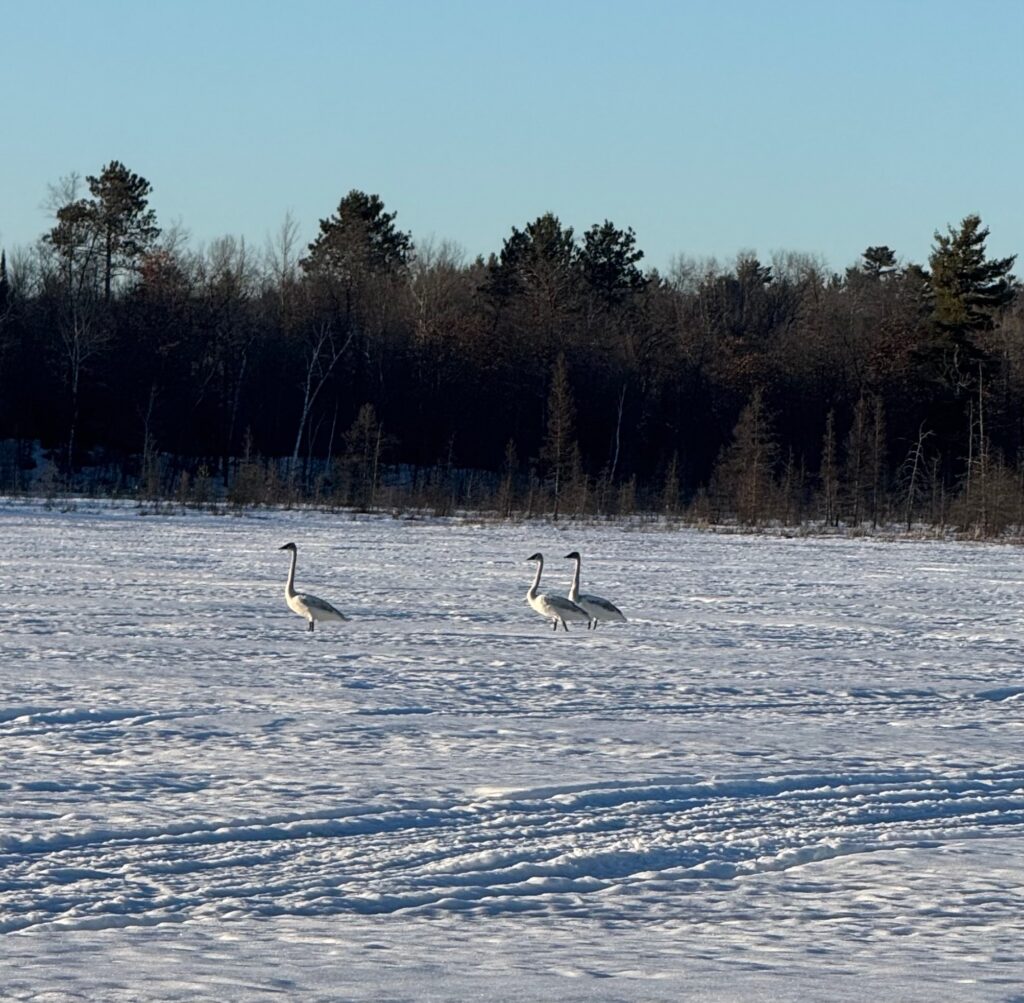
On February 16th I saw three trumpeter swans on the still frozen lake in front of my house. I wondered, why three? Are they earlier this year than they were last year? Are there here because even though the lake is still frozen, might there be some open water up the river the flows into the lake?